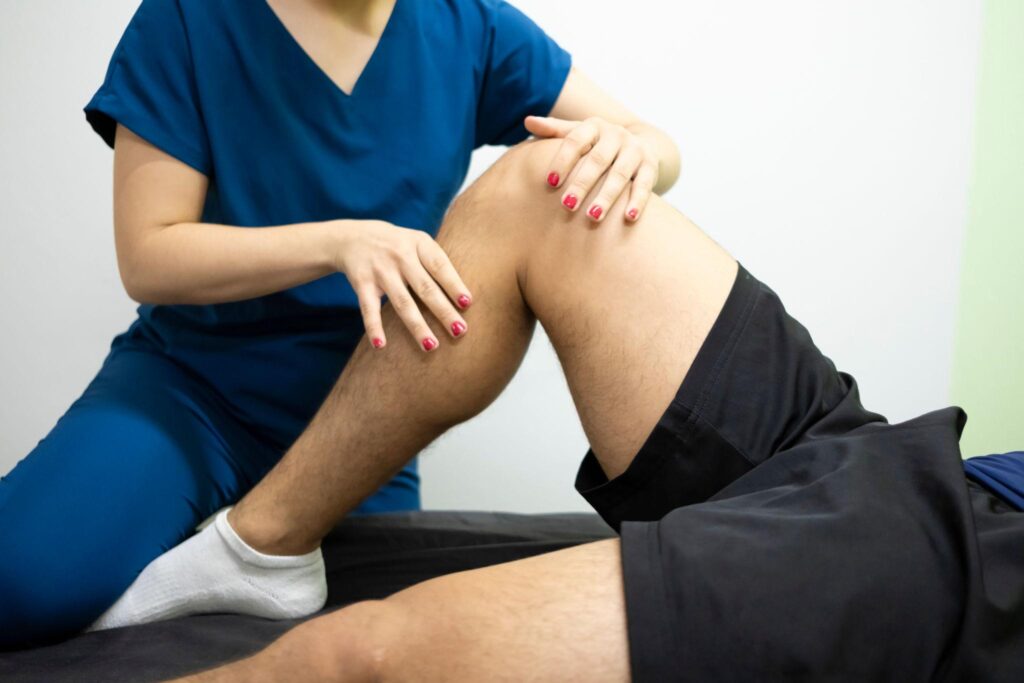
Knee Ligament Injuries
Knee ligament injuries occur when one or more ligaments are stretched or torn, causing pain, swelling, instability, and reduced knee movement after injury.
Understanding Knee Ligament Injuries
The knee contains four main ligaments — the LCL, ACL, PCL, and MCL. Damage to one or more ligaments causes sudden pain, swelling, and difficulty moving or bearing weight. Ligament injuries are graded 1–3, with Grade 3 representing complete rupture.
Causes
- Sprain or tear of one or more ligaments.
- Excessive twisting or force on the knee.
- Falls or direct trauma.
- High-impact sports or auto accidents.
- Sudden missteps or awkward landings.
Symptoms
- A loud pop or tearing sensation.
- Sudden and intense knee pain.
- Swelling within 24 hours.
- Instability or difficulty bearing weight.
- Limited movement due to pain or swelling.
Treatment
Grade 1–2 injuries respond well to physiotherapy focussed on reducing swelling, then strengthening the quadriceps, hamstrings, and gluteal muscles. Grade 3 tears often require
surgery followed by 4–8 months of structured rehabilitation.
Specialist & Regenerative Medicine Options
For partial ligament tears and chronic ligamentous instability, our Prestidge sports physicians can offer targeted treatments to support ligament healing and joint stability as part of an
individualised management plan.
- Platelet Rich Plasma (PRP) Therapy — PRP injected directly into the site of a partial ligament tear or chronic injury delivers a concentrated source of growth factors that accelerate collagen synthesis and tissue repair. PRP is particularly well-evidenced for MCL and LCL partial tears.
- Prolotherapy — One of the most established regenerative treatments for ligament injuries, prolotherapy injections stimulate the body’s natural repair response at the ligament-bone attachment, tightening the joint and reducing chronic instability.
- Stem Cell Therapy — For significant ligament degeneration or partial tears that have failed to heal, stem cell injections (from bone marrow or adipose tissue) can directly contribute to ligament regeneration.
- Corticosteroid Injections — Used short-term to manage acute swelling and pain in the post-injury period, enabling earlier commencement of rehabilitation.
- Hyaluronic Acid — Where ligament injury has led to joint effusion or early cartilage stress, viscosupplementation helps restore the joint environment and reduce secondary damage.
Our sports and exercise physicians at Prestidge work alongside your treating clinician to determine which option best suits your condition, goals, and stage of injury. Image-guided procedures are performed with precision and care. Visit prestidge.com.au to learn more about our full range of specialist services.
Important: All specialist consultations, prescription treatments, and injectable procedures are subject to individual clinical assessment by a registered medical practitioner. Suitability, potential benefits, and risks will be discussed during your consultation. No treatment outcomes are guaranteed. Prescription medicines — including testosterone and peptide therapies — are only available following appropriate medical review and a valid prescription in accordance with TGA and AHPRA
requirements.
Prevention Tips
Building strength and stability in muscles surrounding the knee, regular agility and balance training, consistent year-round conditioning, and proper warm-up and stretching all reduce ligament injury risk.