
Infraspinatus Myofascial Pain Syndrome
Relieve persistent shoulder pain with personalised, evidence-based treatment focused on releasing trigger points, restoring muscle function, and improving comfortable, pain-free movement.
Understanding Infraspinatus Myofascial Pain Syndrome
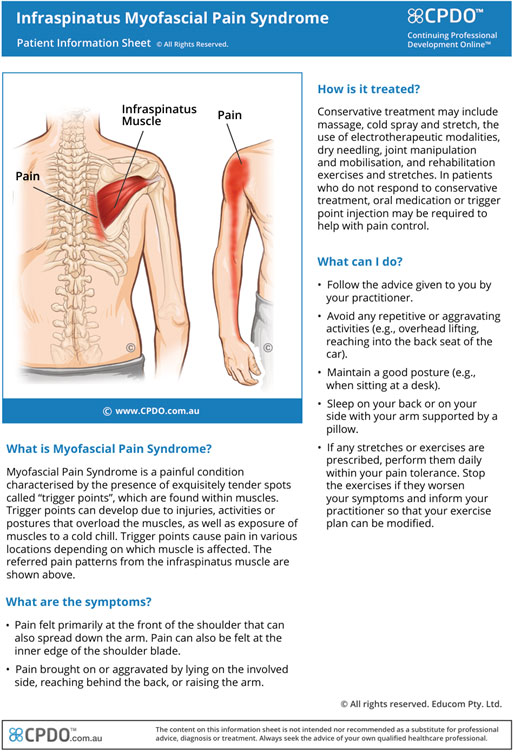
Myofascial Pain Syndrome is a painful condition characterised by the presence of tender trigger points within muscles. The infraspinatus muscle — a key rotator cuff muscle on the back of the shoulder blade — is one of the most clinically significant trigger point locations, as its referred pain pattern closely mimics rotator cuff injury and cervical disc pathology.
Causes
- Repetitive or sustained overhead activity.
- Poor posture at a desk or during driving.
- Reaching behind the back or into the back seat of a vehicle.
- Exposure of the muscle to cold or draughts.
- Muscle overload during sport or manual work.
Symptoms
- Pain at the front of the shoulder extending down the arm.
- Pain at the inner edge of the shoulder blade.
- Pain worsened by lying on the involved side, reaching behind the back, or raising the arm.
- Deep aching shoulder discomfort that is difficult to localise.
Treatment
- Dry needling of infraspinatus trigger points.
- Manual therapy, massage, and myofascial release.
- Cold spray and stretch technique.
- Infraspinatus stretching and strengthening exercises.
- Postural correction and ergonomic assessment.
- Activity modification to avoid aggravating postures.
Rehabilitation & Exercise
Caution: Perform all exercises only as directed by your Healthweave clinician. Stop any exercise that increases your pain and inform your practitioner. Exercise programs are tailored to individual needs and must not be self-prescribed.
Rehabilitation for infraspinatus myofascial pain syndrome focuses on deactivating trigger points and restoring normal muscle function. Avoid aggravating postures — particularly reaching behind the back, sleeping on the involved shoulder, and prolonged overhead activity.
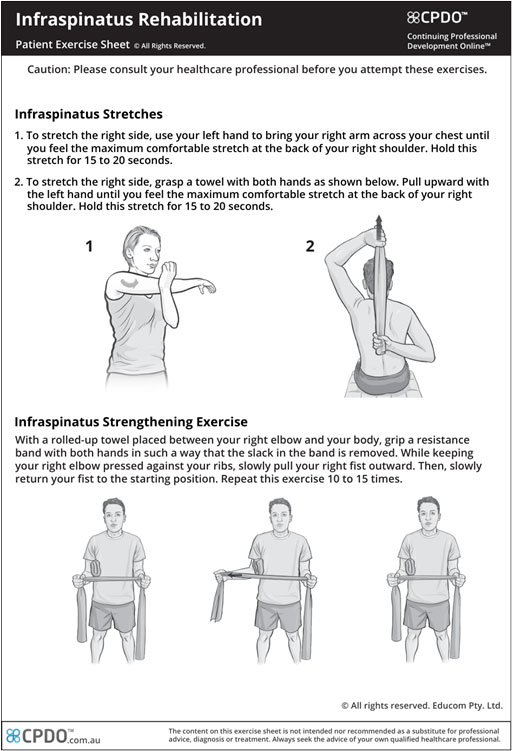
- Infraspinatus cross-arm stretch – arm across the chest to improve shoulder flexibility.
- Towel-assisted posterior shoulder stretch – to restore shoulder mobility.
- External rotation strengthening – using a resistance band to improve rotator cuff strength.
- Scapular retraction and posture correction exercises – to improve shoulder mechanics and posture.
- Postural ergonomic adjustment – for desk and driving positions to reduce muscle strain.
- Sleep position modification – using pillow support for the shoulder to reduce discomfort.