
Frozen Shoulder (Adhesive Capsulitis)
Understanding Frozen Shoulder
Frozen shoulder (adhesive capsulitis) is a condition characterised by progressive pain and severe stiffness of the shoulder joint due to thickening and tightening of the joint capsule. It progresses through three phases: a painful ‘freezing’ phase, a stiff ‘frozen’ phase, and a gradual ‘thawing’ phase — typically lasting 12–36 months in total. With appropriate treatment, recovery can be significantly accelerated. It is more common in women, people aged 40–60, and those with diabetes or thyroid conditions.
Causes
- Idiopathic – no identifiable cause in most cases.
- Previous shoulder injury, surgery, or rotator cuff tear.
- Prolonged immobilisation.
- Diabetes mellitus – significantly increases risk and worsens severity.
- Thyroid disorders.
- Autoimmune or inflammatory conditions.
Symptoms
- Progressive shoulder pain, often severe at night.
- Severe restriction of all shoulder movements – particularly external rotation.
- Inability to perform everyday tasks – dressing, reaching, driving.
- Progressively worsening stiffness even as pain begins to ease.
- Gradual spontaneous improvement over 12–36 months.
Treatment
- Manual therapy and gentle joint mobilisation.
- Capsular stretching within a comfortable range.
- Heat therapy and pain management.
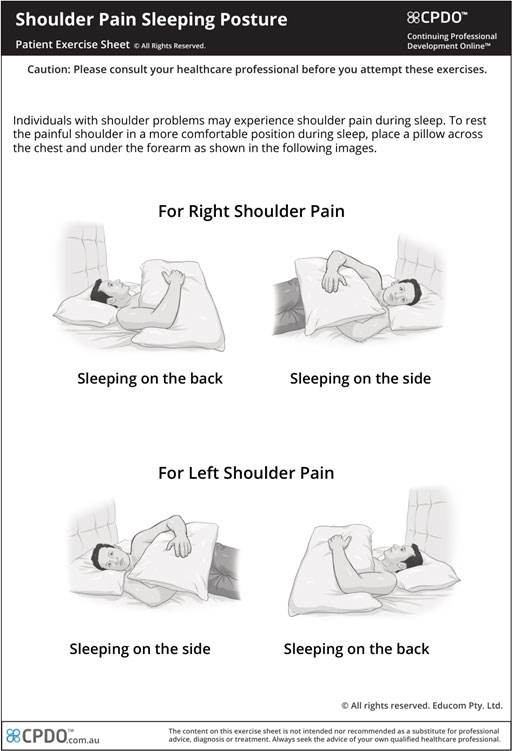
- Sleeping position advice to reduce night pain.
- Progressive strengthening as range of motion improves.
Rehabilitation & Exercise
Caution: Perform all exercises only as directed by your Healthweave clinician. Stop any exercise that increases your pain and inform your practitioner. Exercise programs are designed to individual needs and must not be self-prescribed.
- Pendulum exercises – to gently distract and mobilise the shoulder.
- Assisted shoulder elevation – using a pulley or wand.
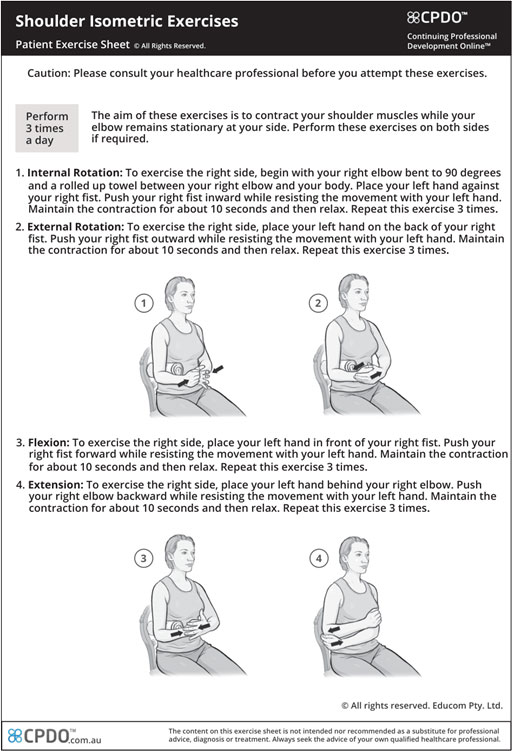
- External and internal rotation stretching – to improve shoulder mobility.
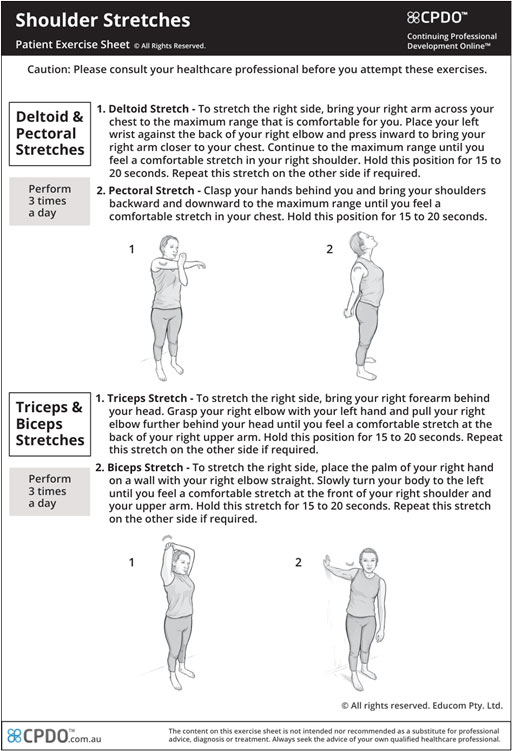
- Deltoid and pectoral stretching – to reduce tightness and improve flexibility.
- Triceps and biceps stretching – for full shoulder and arm mobility.
- Sleeping posture optimisation – using pillow support for the arm.
Specialist & Regenerative Medicine Options
- Corticosteroid Injections – intra-articular steroid injection significantly reduces pain in the freezing phase, enabling more effective physiotherapy.
- Hydrodilatation – distension of the shoulder joint capsule with fluid under image guidance, physically stretching the contracted capsule to accelerate range of motion recovery.
- Platelet Rich Plasma (PRP) – considered for capsular inflammation and remodelling support.
- Manipulation Under Anaesthetic (MUA) or Arthroscopic Capsular Release – for cases that fail to respond to conservative and injection-based care; facilitated through specialist surgical networks.
Important: All specialist consultations, prescription treatments, and injectable procedures are subject to individual clinical assessment by a registered medical practitioner. Suitability, benefits, and risks will be discussed at your consultation. No outcomes are guaranteed. Prescription medicines are only available following appropriate medical review in accordance with TGA and AHPRA requirements. Exercise programs should be performed only as directed by your Healthweave clinician. Exercise images © CPDO / Educom Pty. Ltd. — used under licence.