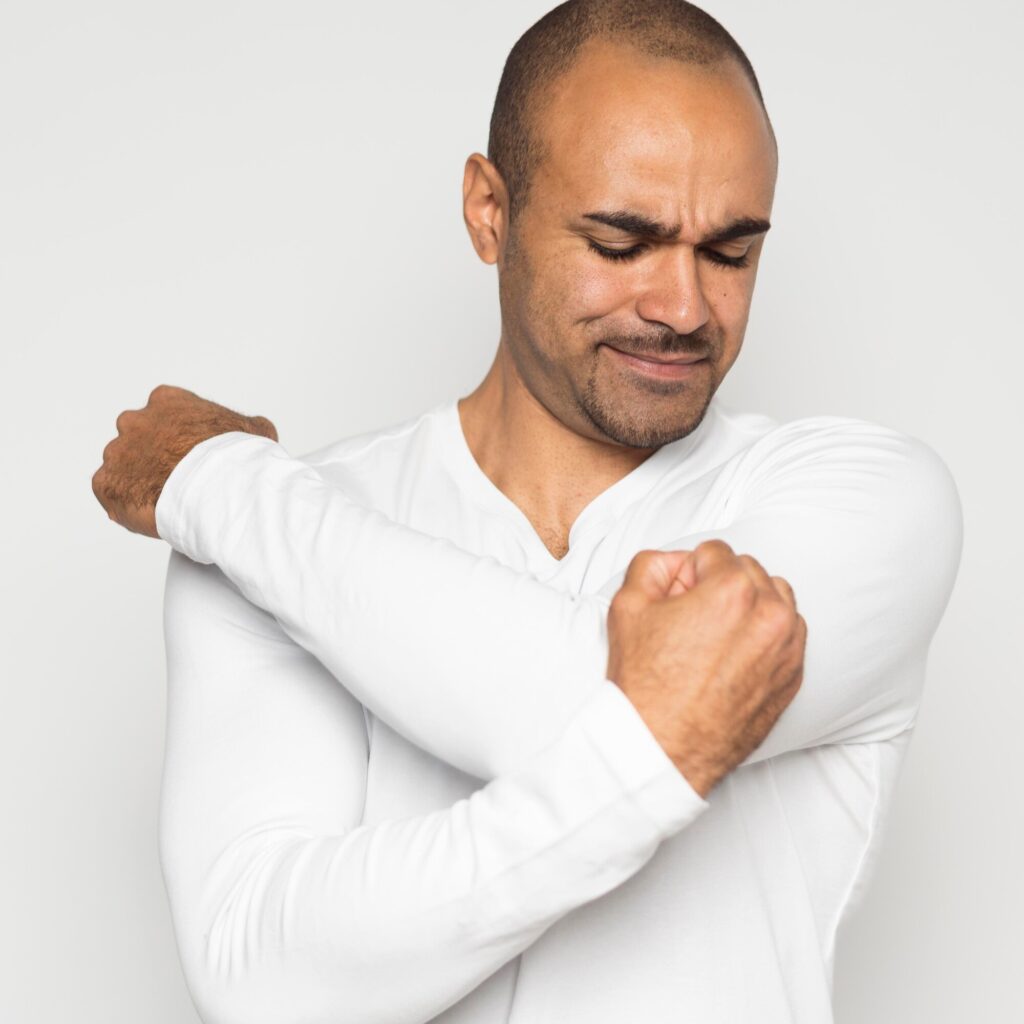
Acromioclavicular (AC) Joint Injury
Restore shoulder comfort and stability with personalised, evidence-based treatment focused on reducing pain, improving movement, and supporting safe return to sport and daily activity after AC joint injury.
Understanding AC Joint Injury
The acromioclavicular joint is a small but important joint at the outer end of the clavicle (collarbone). AC joint injuries are common in contact sports and are typically caused by a direct blow to the shoulder or a fall onto the shoulder or outstretched arm. They range from mild ligament sprains (Grade I) to complete joint separation requiring surgical consideration (Grade III).
Causes
- Shoulder Injuries – collision sports, falls from a bicycle or during skiing.
- Falling onto an outstretched arm.
- Motor vehicle accidents.
Symptoms
- Shoulder Pain and swelling at the tip.
- Pain aggravated by raising the arm above the head.
- Pain when sleeping on the affected side.
- In higher grade injuries – a visible deformity (step) at the AC joint.
- Weakness and restricted shoulder movement.
Treatment
Grade I and II AC joint injuries are managed conservatively and respond well to physiotherapy. Grade III injuries require orthopaedic review to determine whether surgical stabilisation is warranted.
- Initial management: ice, relative rest, and arm support (sling) as required.
- Progressive shoulder mobilisation as pain settles.
- Rotator cuff and scapular stabiliser strengthening.
- Return-to-sport conditioning.
- Post-surgical rehabilitation where indicated.
Rehabilitation & Exercise
Caution: Perform all exercises only as directed by your Healthweave clinician. Stop any exercise that increases your pain and inform your practitioner. Exercise programs are tailored to individual needs and must not be self-prescribed.
AC joint rehabilitation progresses from early pain management and range of motion restoration through to full shoulder strength and sport-specific conditioning. The pace is guided by injury grade and symptom response.
- Gentle pendulum and assisted shoulder mobility exercises – in the early phase.
- Isometric shoulder strengthening – avoiding end-range overhead loading initially.
- Progressive resistance band shoulder strengthening – to restore strength and control.
- Scapular retraction and stabilisation exercises – to improve shoulder mechanics.
- Shoulder stretching – deltoid, pectoral, and triceps.
- Sleeping posture advice – for night pain management.
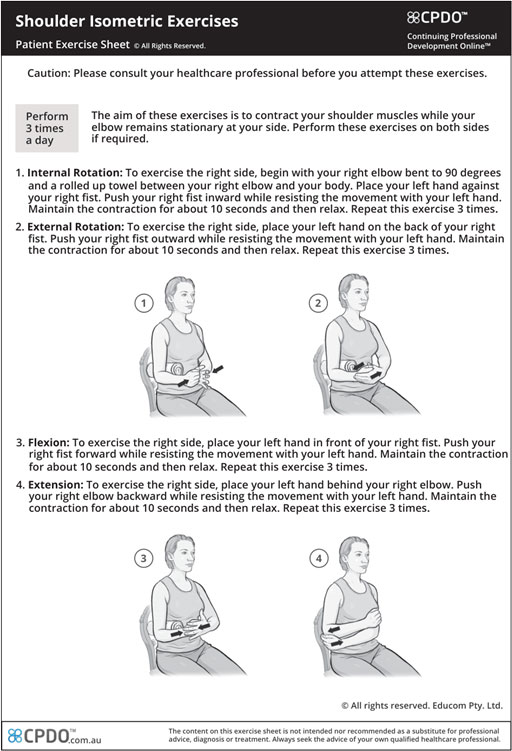
Exercise images © CPDO / Educom Pty. Ltd. — used under clinical licence | healthweave.com.au
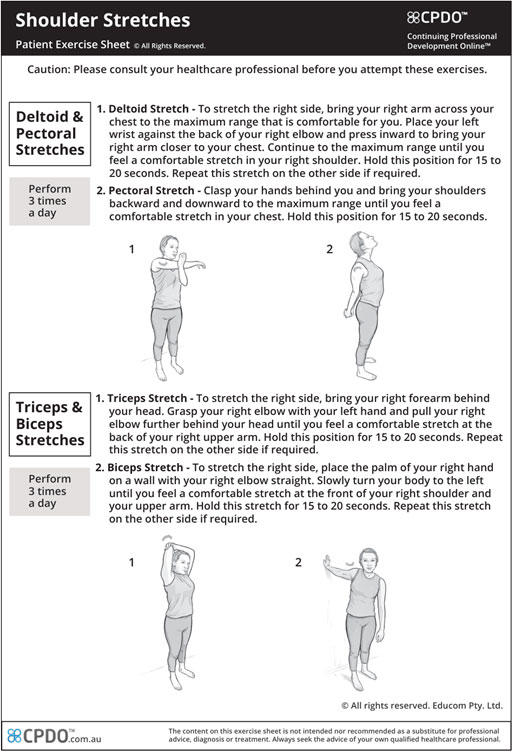
Exercise images © CPDO / Educom Pty. Ltd. — used under clinical licence | healthweave.com.au
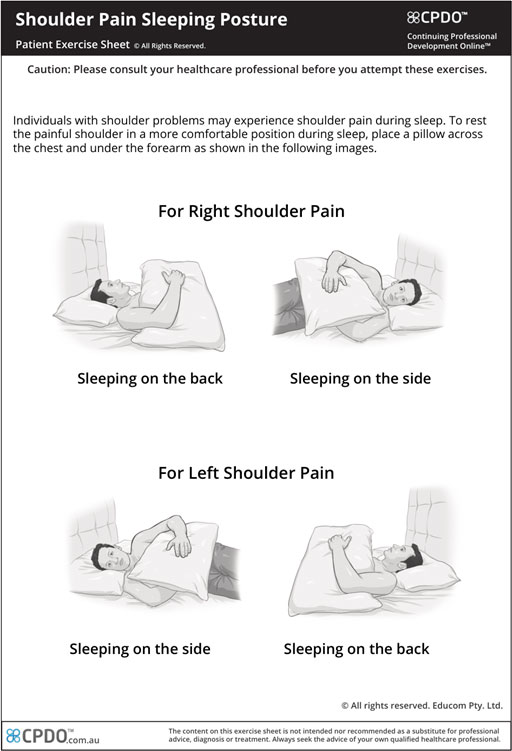
Exercise images © CPDO / Educom Pty. Ltd. — used under clinical licence | healthweave.com.au