Concussion
Receive expert concussion assessment and personalised rehabilitation focused on safe recovery, symptom management, and a medically supervised return to sport, work, school, and everyday activities.
Understanding Concussion
Concussion is a functional brain injury caused by a direct blow to the head or an indirect force that accelerates and decelerates the brain (e.g., whiplash). It does not require loss of consciousness. With any head trauma, internal bleeding and serious brain injury must always be excluded — concussion requires immediate clinical assessment and appropriate medical clearance before return to sport or activity.
Symptoms
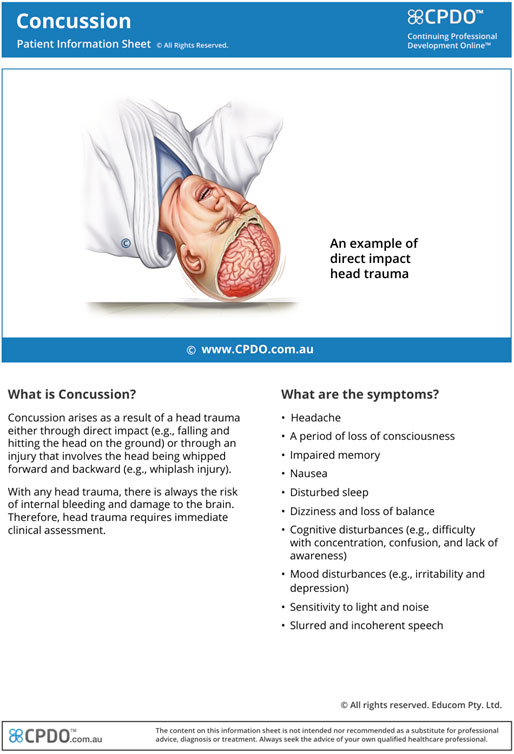
- Headache – the most common symptom.
- A period of confusion, disorientation, or loss of consciousness.
- Impaired memory – particularly of events immediately before or after the injury.
- Nausea or vomiting.
- Disturbed or altered sleep patterns.
- Dizziness and balance difficulties.
- Sensitivity to light and noise.
- Cognitive disturbances – difficulty concentrating and confusion.
- Mood disturbances – irritability, anxiety, or depression.
- Slurred or incoherent speech.
Red flags requiring emergency assessment: severe headache, repeated vomiting, seizures, limb weakness, loss of consciousness lasting more than one minute, or any neurological deterioration. Call 000 immediately.
What You Should
- Seek immediate clinical assessment following any head trauma.
- Do not return to sport, driving, or exercise until formally cleared by a qualified clinician.
- Rest cognitively as well as physically in the early phase – reduce screen time, reading, and mental effort.
- Avoid alcohol.
- Inform your treating clinician of all symptoms, including emotional and sleep changes.
- Follow a structured, graduated return-to-sport and return-to-learn protocol.
Treatment
Concussion management is directed by a qualified clinician experienced in concussion assessment. The cornerstone is structured physical and cognitive rest followed by a carefully graduated return to activity — not rushing back too quickly.
- Clinical concussion assessment and symptom monitoring.
- Graduated return-to-sport protocol under clinician supervision.
- Vestibular rehabilitation where dizziness and balance issues persist.
- Cervical spine treatment where neck injury accompanies concussion.
- Education on symptom management and recovery expectations.
- Psychological support where mood and cognitive symptoms are prominent.
All return-to-sport decisions following concussion must be made by a qualified health professional. Premature return to contact sport following concussion significantly increases the risk of further brain injury.