{ "@context": "https://schema.org/", "@type": "WebSite", "name": "Prestidge Chiropract", "url": "https://www.prestidge.com.au/" } { "@context": "https://schema.org/", "@type": "LocalBusiness", "name": "Prestidge Chiropractic", "url": "https://www.prestidge.com.au/", "address": { "@type": "PostalAddress", "addressCountry": "AU", "addressLocality": "Fairlight", "postalCode": "2094", "streetAddress": "239 Sydney Road" } }

prestidge.com.au

Sternoclavicular (SC) Joint Sprain

Restore shoulder comfort and stability with personalised, evidence-based treatment focused on reducing pain, protecting the joint, and safely guiding you back to full shoulder movement and activity after SC joint injury.

Understanding Sternoclavicular Joint Sprain

The sternoclavicular joint connects the inner end of the clavicle (collarbone) to the manubrium (breastbone). It is the only bony connection between the arm and the axial skeleton and is essential for normal shoulder movement. SC joint sprains occur from direct trauma, contact sports injuries, and motor vehicle accidents. Like AC joint injuries, they range from mild sprains to complete ligament rupture.

Causes

  • Direct blow to the front of the chest.
  • Falls – particularly onto an outstretched arm.
  • Contact sports – rugby, AFL, wrestling.
  • Motor vehicle accidents.

Symptoms

  • Chest pain at the base of the neck near the inner collarbone.
  • Pain worsening with arm elevation.
  • Pain on sleeping on the involved side.
  • Pain with neck movements.
  • In severe cases – swelling and visible deformity at the SC joint.

Treatment

Mild-to-moderate SC joint sprains respond well to conservative management. Severe injuries with posterior dislocation require urgent medical assessment due to proximity to vital structures.
  • Ice and relative rest in the acute phase.
  • Arm support (sling) for comfort during healing.
  • Progressive shoulder mobility and strengthening.
  • Manual therapy as healing progresses.
  • Return-to-sport conditioning.

Rehabilitation & Exercise

Caution: Perform all exercises only as directed by your Healthweave clinician. Stop any exercise that increases your pain and inform your practitioner. Exercise programs are tailored to individual needs and must not be self-prescribed.

SC joint rehabilitation mirrors AC joint rehabilitation in its progression — early pain management followed by gradual restoration of shoulder mobility and strength. Full shoulder range is restored before sport-specific conditioning.

  • Gentle shoulder mobility exercises within a comfortable range.
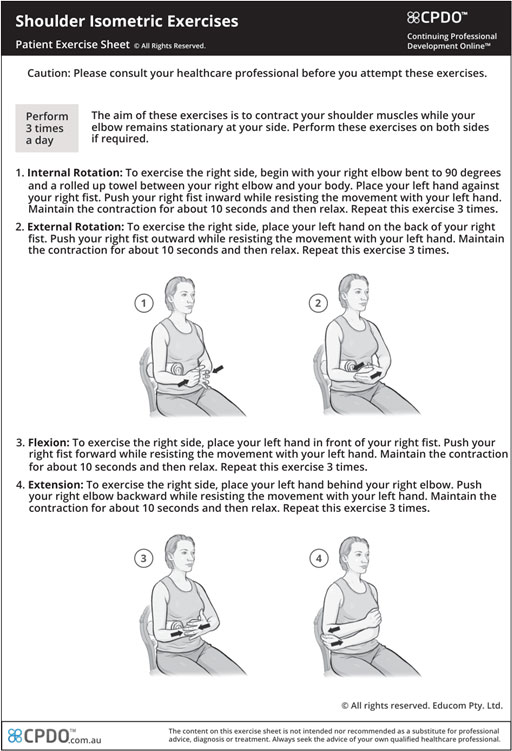
  • Isometric shoulder strengthening in the subacute phase.
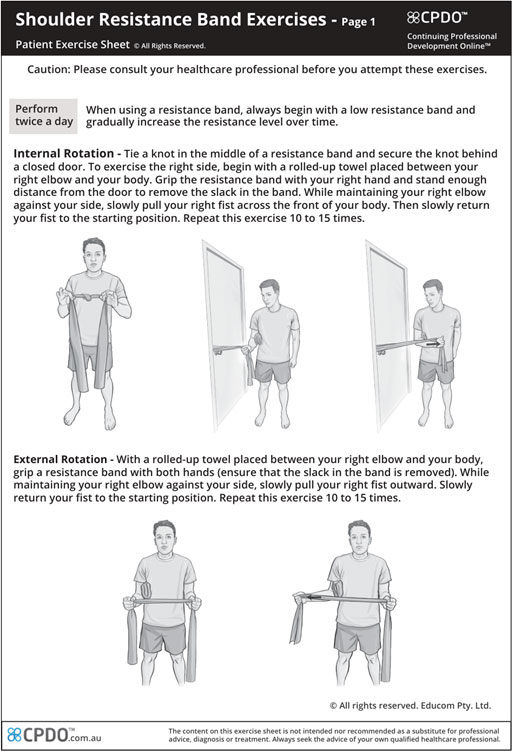
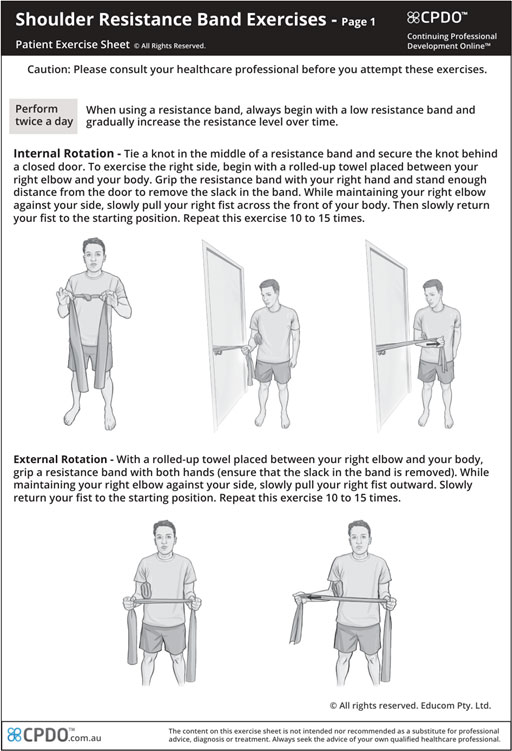
  • Progressive resistance band and functional strengthening.
  • Pectoral and anterior shoulder stretching.
  • Cervical mobility exercises where neck pain is present.
Exercise images © CPDO / Educom Pty. Ltd. — used under clinical licence | healthweave.com.au