Tennis Elbow (Lateral Elbow Tendinopathy)
Understanding Tennis Elbow
Causes
- Repetitive gripping, lifting, or wrist extension.
- Occupational overuse – tools, keyboards, and manual work.
- Racquet sports with poor technique or heavy equipment.
- Sudden increase in forearm activity or load.
- Weak forearm muscles and poor ergonomic setup.
Symptoms
- Pain or burning on the outer elbow.
- Tenderness over the lateral epicondyle.
- Pain extending down the forearm with gripping or lifting.
- Weakness of grip – difficulty holding a cup or shaking hands.
- Pain with wrist extension, typing, or forearm rotation.
- Gradual onset worsening with continued activity.
Treatment
Physiotherapy is the cornerstone of tennis elbow management. A structured program addressing tendon loading, muscle strengthening, and ergonomic factors produces excellent outcomes, particularly when commenced early.
- Progressive eccentric and isometric forearm strengthening.
- Manual therapy and soft tissue release.
- Counterforce bracing during activity.
- Activity modification and ergonomic assessment.
- Dry needling to the extensor muscles.
Rehabilitation & Exercise
Caution: Perform all exercises only as directed by your Healthweave clinician. Stop any exercise that increases your pain and inform your practitioner. Exercise programs are tailored to individual needs and must not be self-prescribed.
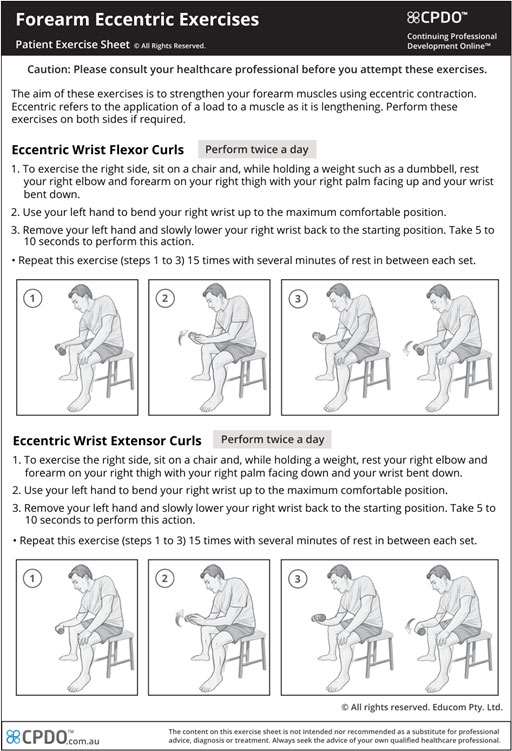
- Eccentric wrist extensor curls – the cornerstone of tendon rehabilitation.
- Eccentric wrist flexor curls – for forearm balance.
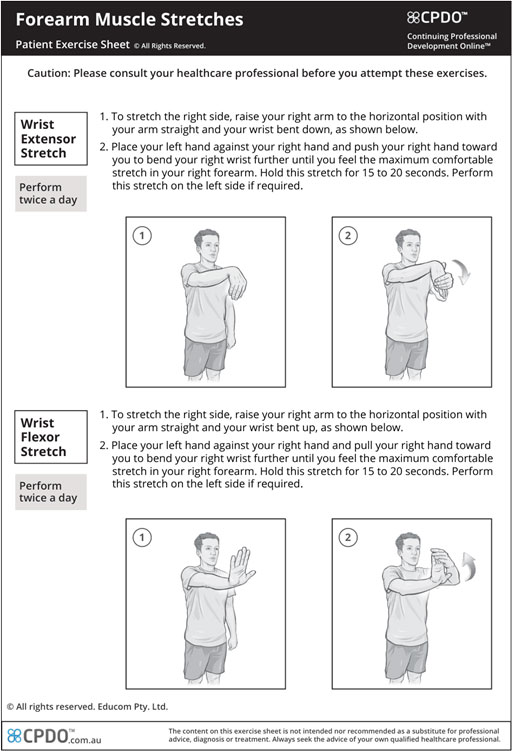
- Wrist extensor and flexor stretching – held for maximum comfortable stretch.
- Grip strengthening exercises – as symptoms permit.
- Ergonomic correction – of workstation and tool technique.
Specialist & Regenerative Medicine Options
For chronic tennis elbow (lasting beyond 3–6 months) or significant tendon degeneration on imaging, our Prestidge sports physicians can offer targeted regenerative treatments.
- Platelet Rich Plasma (PRP) Therapy – one of the most well-researched regenerative treatments for lateral elbow tendinopathy. Ultrasound-guided PRP into the degenerate tendon delivers growth factors to support collagen repair.
- High-Volume Injection (HVI) – to address abnormal tissue changes within the tendon.
- Dry Needling under Ultrasound (Tenotomy/Fenestration) – image-guided needling stimulates a healing cascade within degenerate tissue.
- Prolotherapy – injection to support the lateral epicondyle enthesis.
- Corticosteroid Injections – used selectively for acute pain management; repeated injections may impair tendon healing.
- Peptide Therapy – where clinically appropriate following individual assessment. A valid prescription is required.
Our sports and exercise physicians at Prestidge work alongside your treating clinician to determine the most appropriate option for your condition, goals, and stage of recovery. All injectable and prescription treatments are subject to individual clinical assessment. Visit healthweave.com.au or prestidge.com.au to learn more.
All specialist consultations, prescription treatments, and injectable procedures are subject to individual clinical assessment by a registered medical practitioner. Suitability, benefits, and risks will be discussed at your consultation. No outcomes are guaranteed. Prescription medicines are only available following appropriate medical review in accordance with TGA and AHPRA requirements. Exercise programs should be performed only as directed by your Healthweave clinician. Exercise images © CPDO / Educom Pty. Ltd. — used under licence.